
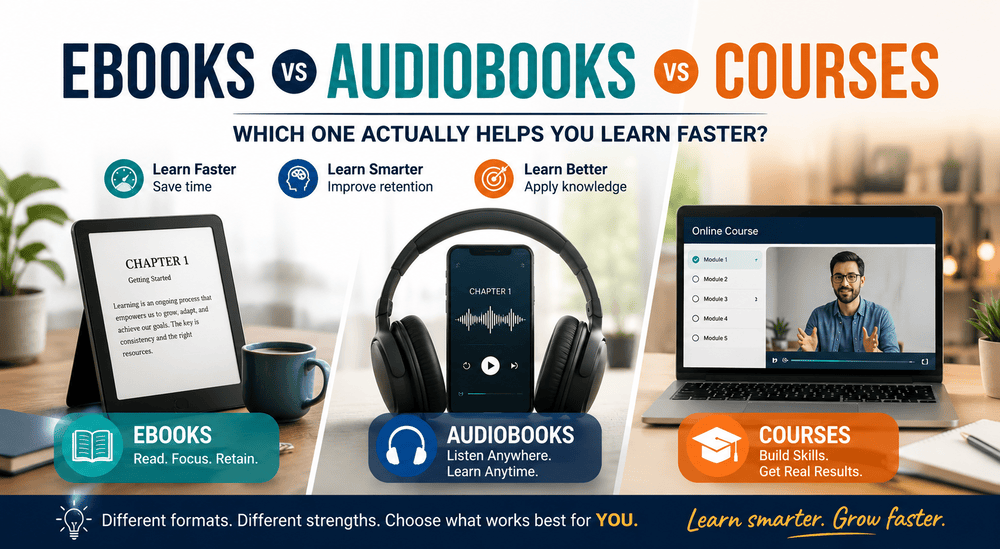
Learning has never been more accessible. Today, you can read an eBook on your phone, listen to an audiobook during your commute, or enroll in an online course from the comfort of your home. With so many options available, one question often comes up:
Which format helps you learn faster: eBooks, audiobooks, or online courses?
The answer depends on your learning style, goals, schedule, and the type of information you want to absorb. In this guide, we'll compare eBooks, audiobooks, and courses to help you choose the best format for faster and more effective learning.

Why Learning Speed Isn't Everything
Before comparing formats, it's important to understand that learning fast doesn't always mean learning well.
True learning involves:
- Understanding concepts
- Retaining information
- Applying what you've learned
- Remembering it over time
The fastest learning method is often the one that fits naturally into your lifestyle while helping you retain information effectively.
Let's look at how each format performs.
eBooks: Fastest for Focused Learning
eBooks remain one of the most efficient ways to learn new information.
Unlike videos or audio content, eBooks allow you to control the pace completely. You can skim sections, reread important passages, highlight key points, and jump directly to the information you need.
Advantages of eBooks
1. Faster Consumption
Many people read significantly faster than they listen. A typical audiobook is narrated at around 150 words per minute. Meanwhile, the average adult reads between 200 and 300 words per minute, with experienced readers often reading even faster.
This means you can often finish an eBook in less time than its audiobook equivalent.
2. Easy to Search and Reference
Need to review a specific chapter? With eBooks, you can quickly search for keywords, bookmarks, or highlights. This makes them ideal for topics that require review and repetition.
3. Better for Deep Learning
Complex subjects often require careful reading.
Topics such as:
- History
- Business strategy
- Academic subjects
- Technical skills
- Research-based content
are often easier to understand when you can pause and revisit difficult sections.
Drawbacks of eBooks
- Require dedicated reading time
- Can be difficult to focus on if you're tired
- Less convenient while driving or exercising
Best For
eBooks are ideal for learners who want maximum control over their learning experience and prefer reading at their own pace.
Audiobooks: Best for Learning on the Go
Audiobooks have exploded in popularity over the past few years, and for good reason. They transform otherwise unproductive moments into learning opportunities.
Advantages of Audiobooks
1. Learn During Daily Activities
One of the biggest benefits of audiobooks is convenience.
You can listen while:
- Driving
- Walking
- Exercising
- Cleaning
- Commuting
This allows you to fit learning into your day without setting aside extra time.
2. Great for Storytelling and Narrative Content
Some subjects work exceptionally well in audio format.
Examples include:
- Biographies
- Personal development
- History stories
- Memoirs
- Motivational content
A skilled narrator can make the material more engaging and memorable.
3. Reduces Screen Time
Many people spend most of their day looking at screens. Audiobooks offer an alternative way to consume content without additional screen exposure.
Drawbacks of Audiobooks
- Harder to take notes
- Easier to become distracted
- Slower than reading
- Difficult to review specific sections
Studies have shown that comprehension can be similar between reading and listening, but retention often depends heavily on attention levels. If you're multitasking, you may miss important details.
Best For
Audiobooks are best for busy people who want to maximize learning during daily routines and downtime.
Online Courses: Best for Skill Development
Online courses have become one of the most popular learning tools available today. Unlike ebooks and audiobooks, courses often combine multiple learning methods, including video lessons, quizzes, assignments, and practical exercises.
Advantages of Courses
1. Structured Learning Path
Courses are designed to guide learners step-by-step. Instead of figuring out what to learn next, the curriculum is already organized for you. This can significantly reduce confusion and save time.
2. Practical Application
Many courses include:
- Exercises
- Projects
- Worksheets
- Assessments
These activities help reinforce learning and improve retention.
3. Visual Demonstrations
Certain skills are easier to learn through visual instruction.
Examples include:
- Graphic design
- Photography
- Programming
- Video editing
- Digital marketing
Watching someone perform a task can accelerate understanding.
Drawbacks of Courses
- Often more expensive
- Can require larger time commitments
- Risk of information overload
- Completion rates are often low
Many learners purchase courses but never finish them.
Without consistent action, even the best course provides little value.
Best For
Courses are ideal when you want to develop a practical skill that requires demonstrations, exercises, and guided instruction.
Which Format Helps You Learn Faster?
The answer depends on your objective.
If You Want Information Quickly
Winner: eBooks
Reading is generally faster than listening, and eBooks allow you to skim, search, and review content efficiently.
If You Have Limited Free Time
Winner: Audiobooks
Audiobooks turn commuting, walking, and household chores into learning opportunities.
If You Want to Master a Skill
Winner: Courses
Courses provide structured lessons and practical exercises that help transform knowledge into real-world ability.
The Smartest Approach: Combine All Three
Many successful learners don't choose just one format. Instead, they combine multiple formats to maximize results.
For example:
- Read an eBook to gain a broad understanding.
- Listen to the audiobook for reinforcement.
- Take a course to apply what you've learned.
This multi-format approach leverages repetition, one of the most powerful learning techniques available.
Research consistently shows that repeated exposure to information improves retention and long-term recall.
How to Choose the Right Learning Format
Ask yourself these questions:
What Is My Goal?
- Learning information → eBook
- Learning while multitasking → Audiobook
- Building a skill → Course
How Much Time Do I Have?
- Dedicated study time → eBook or course
- Busy schedule → Audiobook
How Do I Learn Best?
- Visual learner → eBook or course
- Auditory learner → Audiobook
- Hands-on learner → Course
Understanding your preferences can help you learn more efficiently and stay motivated.
Final Thoughts
When comparing eBooks vs audiobooks vs courses, there is no universal winner. For pure speed and efficient knowledge acquisition, eBooks often come out on top. They allow faster consumption, easier review, and deeper engagement with complex topics.
Audiobooks excel when convenience matters most, making them perfect for busy lifestyles.
Courses shine when practical skill development is the goal, offering structured guidance and hands-on learning opportunities.
The best learning format is ultimately the one you'll use consistently. If you're looking for affordable and flexible learning resources, eBooks remain one of the most effective tools available. They provide instant access to knowledge, allow self-paced learning, and make it easy to revisit important concepts whenever needed.
Whether you're trying to learn a new skill, improve your career, or simply expand your knowledge, choosing the right format can help you learn smarter—not just faster.
***
I'm selling educational and entertaining eBooks! You may want to check them here:
- Churches of Nueva Ecija (Cabiao, San Isidro, Gapan, and San Antonio) eBook
- Echoes of San Antonio: The Last Heritage Houses
- True Philippine Ghost Stories eBook Collection (Books 1–37): Complete Bundle of Classic Filipino Horror | Nostalgic & Spine-Chilling Reads
- Over 50,000 Resellable eBooks: Your Ready-Made Digital Business Solution
- TikTok Shop / Affiliate Marketing Blueprint 2026
***
Similar stories:
Comments ()