
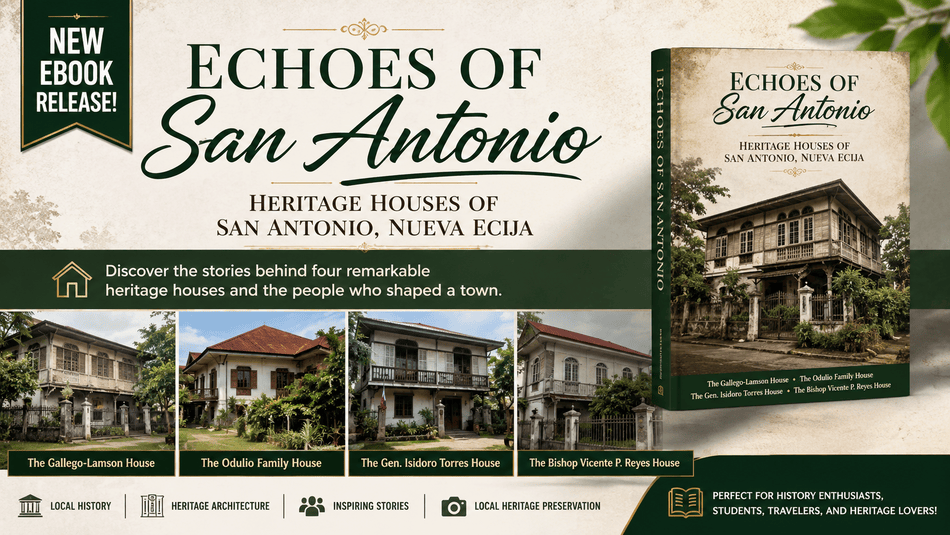
Every old house has a story to tell. Some witnessed the town's earliest celebrations, while others stood through wars, political changes, and generations of families who helped shape their community. These structures are more than beautiful architecture—they are tangible reminders of the people and events that defined local history.
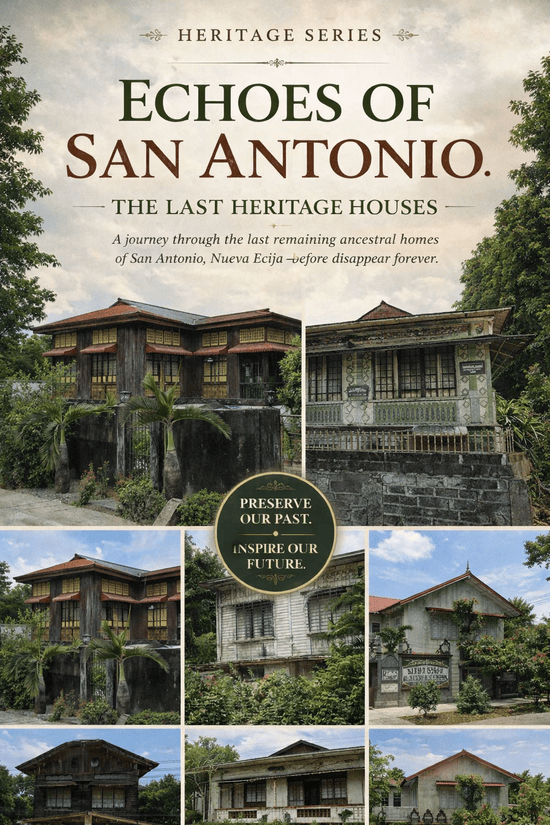
That's the inspiration behind my latest eBook, Echoes of San Antonio: Heritage Houses of San Antonio, Nueva Ecija.
This project is a tribute to several of the town's most significant ancestral homes, highlighting their history, architecture, and the families who once lived in them. If you're passionate about Philippine heritage, local history, or heritage tourism, this eBook offers a closer look at landmarks that deserve greater recognition.
Why I wrote this eBook
I've always believed that history isn't found only in museums or textbooks. Sometimes, it's hidden in plain sight—in old churches, public plazas, forgotten monuments, and ancestral houses that people pass by every day without realizing their historical significance.
San Antonio, Nueva Ecija, is home to several heritage houses that quietly tell the story of the town's growth over the decades. While some residents are familiar with these homes, very little information about them has been compiled in one place.
I wrote Echoes of San Antonio to help preserve these stories and make them more accessible to history enthusiasts, students, researchers, travelers, and fellow heritage advocates.
My goal wasn't simply to document old buildings. I wanted to highlight the people behind them and show how these homes reflect the cultural identity of San Antonio.
What's inside the eBook?
Echoes of San Antonio explores four of the town's notable heritage houses, each with its own unique history and contribution to the municipality.
The eBook features:
The Gallego-Lamson House
Learn about one of San Antonio's historic ancestral homes and the family connected to it. The chapter explores the house's historical background, architectural features, and its place in the town's heritage.
The Odulio Family House
Discover the story behind another well-preserved heritage residence that reflects the lifestyle, traditions, and craftsmanship of an earlier generation. The eBook examines its historical significance and the family's connection to the local community.
The Gen. Isidoro Torres House
General Isidoro Torres is an important figure in Philippine history, and this chapter explores the ancestral house associated with him. Readers will gain insight into his legacy while learning about the historical value of the property that bears his name.
The Bishop Vicente P. Reyes House
This chapter introduces readers to the ancestral home connected to Bishop Vicente P. Reyes, one of San Antonio's notable religious figures. It discusses his life, contributions, and why preserving places associated with him remains important for future generations.
Each chapter combines historical information, local context, and observations that help readers appreciate these structures beyond their physical appearance.
More than Architecture
At first glance, heritage houses may simply appear to be old buildings. However, they represent much more than their walls, windows, and wooden floors.
These homes provide valuable insight into:
- The lives of some of the prominent families in San Antonio
- Traditional Filipino residential architecture
- The town's social and cultural development
- Local craftsmanship and construction techniques
- Important historical personalities connected to the municipality
By understanding these houses, readers also gain a better understanding of San Antonio's story.
Why heritage preservation matters
Across the Philippines, many ancestral houses have already been demolished or altered beyond recognition due to urban development, neglect, or natural disasters.
Every time a historic structure disappears, a piece of local history disappears with it.
While not every old house can become a museum, documenting their stories is one meaningful way to preserve their legacy. Through this eBook, I hope to encourage greater appreciation for heritage conservation and inspire readers to look more closely at the historic landmarks in their own communities.
Preserving history doesn't always require restoring a building—it can also begin by learning about it, sharing its story, and recognizing its significance.
Who should read this eBook?
This eBook is ideal for anyone interested in Philippine history and culture, including:
- Heritage enthusiasts
- Architecture lovers
- Students and educators
- Local historians
- Researchers
- Travelers exploring Nueva Ecija
- Genealogy enthusiasts
- Anyone curious about San Antonio's past
Whether you're a resident of San Antonio or someone discovering the town for the first time, you'll find stories that deepen your appreciation for its historical landmarks.
What makes this eBook different?
There are many books that discuss famous heritage houses in cities like Vigan, Taal, or Silay. However, smaller municipalities often receive far less attention despite having equally meaningful historical sites.
Echoes of San Antonio focuses on a specific community, giving readers an opportunity to discover heritage houses that may not appear in mainstream travel guides or history books.
Instead of presenting only architectural descriptions, the eBook connects each house with the people who lived there and the role they played in shaping the town's identity. This approach makes the stories more personal and highlights why these structures remain relevant today.
A resource for travelers and heritage advocates
If you enjoy exploring historical destinations, this eBook can also serve as an introduction to some of San Antonio's notable landmarks. Reading about these houses before visiting them adds another layer of appreciation, allowing you to better understand their historical and cultural significance.
For heritage advocates, the book is a reminder that preserving local history starts with documenting and sharing it. Many communities across the Philippines have remarkable stories waiting to be told, and these ancestral homes are among San Antonio's most valuable historical treasures.
Where to Get Echoes of San Antonio
If you'd like to learn more about the heritage houses featured in this collection, you can purchase Echoes of San Antonio: Heritage Houses of San Antonio, Nueva Ecija through my online store:
👉 Echoes of San Antonio: The Last Heritage Houses
After purchase, you'll receive a digital copy that you can read on your smartphone, tablet, laptop, or eReader whenever it's convenient for you.
Final Thoughts
Writing Echoes of San Antonio has been one of my most rewarding projects because it allowed me to document an important part of my hometown's heritage. The Gallego-Lamson House, the Odulio Family House, the Gen. Isidoro Torres House, and the Bishop Vicente P. Reyes House each tell a different story, yet together they paint a richer picture of San Antonio's history and cultural identity.
I hope this eBook encourages readers to appreciate not only these remarkable heritage houses but also the countless ancestral homes found throughout the Philippines. Every historic structure has the potential to teach us something about the people who came before us, and preserving those stories helps ensure they continue to inspire future generations.
If you enjoy local history, heritage architecture, or discovering lesser-known historical landmarks, I invite you to explore Echoes of San Antonio and experience the stories preserved within its pages.
Similar stories:
Comments ()